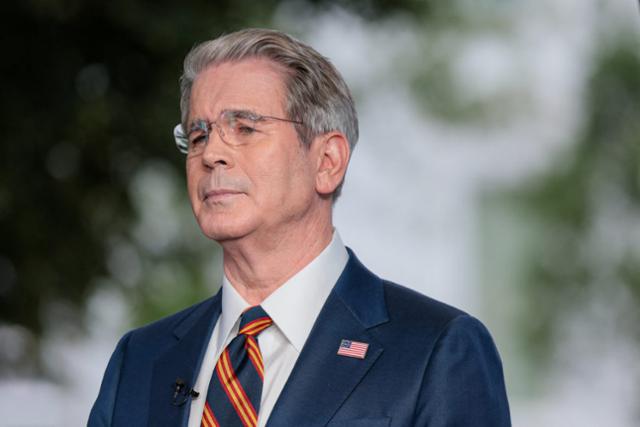
Treasury Secretary Bessent Says K-Shaped Economy 'Is Over'; Experts Debate
Amid ongoing concerns about affordability for many Americans, Treasury Secretary Scott Bessent recently stated that the U.S. economy is no longer experiencing a "K-shaped" recovery—a term that describes growing financial gaps between high- and low-income households. In an August 4 interview with CNBC, Bessent expressed frustration with the frequent references to the "K-shaped economy" and declared definitively that it is over.
Historically, the "K-shaped" term has been used for years by economists and analysts to highlight a pattern where spending and wage growth among higher-income Americans outpace those of lower-income groups. Former Federal Reserve Chair Jerome Powell acknowledged this trend last December, noting that many consumer-facing companies serving low- and moderate-income customers reported belt-tightening and reduced spending.
However, Bessent contends that this dynamic has shifted toward a "C-shaped" economy, pointing to evidence of faster wage increases for low-income Americans relative to those in higher-income brackets. This suggests a narrowing of income disparities, though the overall economic picture remains complex.
While some economists recognize signs of this transition with the gap between income groups slightly lessening, they caution that declaring the end of the K-shaped economy is premature. Peter Orszag, CEO of Lazard, remarked on CNBC that the evidence does not yet support a definitive conclusion that the K-shaped pattern has ended.
Additional economic factors, including geopolitical tensions such as the war in Iran, fluctuating gas prices, and inflationary pressures, also influence the outlook. Deon Strickland, a financial services professor at Wake Forest University, told PBS News that the likelihood remains higher for the continuation of the K-shaped economy rather than a full shift to the C-shaped model.
As discussions continue, the debate highlights the challenges in interpreting economic data amid evolving conditions and the importance of monitoring wage and spending trends across income groups to understand the true shape of the U.S. economy.